Short Fiction
1080 Paths of Least Resistance
“This the right door?” Sal asked.
1080 pulled out his phone and opened Dimitri’s video. The rifle strap across his chest creaked as he lifted his arm.
The title read: Exploring the Complex — 346 views • posted 2 days ago.
The screen jittered with grainy light as the kid stumbled down a concrete landing, laughing under his breath. Then the video showed a metal door: chipped paint, rust at the hinges, the arrow below it pointing down. Dimitri opened the door and went inside, now looking at a staircase. To the left, on the wall at the top of the stairs was a sign, partly outside the video’s frame, that seemed to read, “ub Leve”. Halfway down the stairs, a human-sounding voice is heard, before the screen glitches and the video cuts off.
1080 replayed the video and froze the frame on the door. Same scratches. Same chipped paint.
1080 lowered his phone.
“Yeah,” he said. “This is it.”
Sal glanced at the screen, then the door. “Your nephew really broke in alone?”
1080 rolled his eyes. “Not helpful.”
Sal let out a breath that tried to sound amused and didn’t quite make it. “Great.”
1080 pocketed his phone. He opened the stairwell door. To the left, a sign read:
“Negative one?” Sal said.
“Basement,” 1080 muttered.
“Basement’s zero.”
“... Just keep walking.”
On the stairs leading to Sub Level B of Floor -1, the smell swung from burnt wiring, to something deeper: wet concrete, old bread, the patient damp of a basement that doesn’t know it’s underground. And something started to feel off.
Real off.
Their breath fogged the inside of the visors. They descended, boots clapping the metal treads. The stairwell vibrated faintly, as if something below had heard him.
By the time they got to the bottom of the stairs, condensation beaded on their gloves. Somewhere beyond the dim, water dripped in an irregular rhythm: two drops. Silence. One drop. Pause... as though the pipes themselves were hesitating.
Attached to a thin metal pole in the ground, a sign read:
“Whatever that means...” muttered Sal.
An old, wooden office table leaned crooked against one wall, cluttered with clipboards and a drawer hanging open. Inside, rubber bands fossilized to the mix of wood and old air, a pen with its spring sticking out like a tongue, and a laminated log sheet that had bled at the corners. Down in the margins, written in different ink:
Sometimes the walls remember us better than we remember ourselves.
Sal stared at it, visor almost hiding his eyes. “Who wrote that?”
“Someone with a better pen.” 1080 quipped.
They stepped through the next door, and emerged into a set of rooms whose geometry slipped. Walls with old yellowed wallpaper and black chevron arrows pointing up, with seams like healed cuts. The walls stretched on in every direction, one corridor folding into another like a badly shuffled deck of cards. There were random load-bearing pillars around. Ceiling tiles that didn’t fully line up with the floor. 1080 forced his boots forward over the damp carpet. Each step sank just slightly, enough to remind him that the floor was wrong; too damp and spongy, releasing a squelching squish with each stride. Fluorescents hummed overhead. The hum felt almost alive.
A wooden chest of drawers hunched over in one corner, two handles missing. A deflated soccer ball lay where a wall met a wall at a wrong angle, crusted like it had rolled through a shipwreck. Along the ceiling, human-sized dominoes leaned like tired men, deep black pits watching.
Sal stepped forward and immediately clipped something with his boot.
The metal bucket skittered across the floor with a hollow clang and rolled into the dark down the corridor.
“Oops—”
They went on.
Something made a clicking sound up above, and the air blew cold. 1080 almost smiled. It was just the AC, but it meant something was still working.
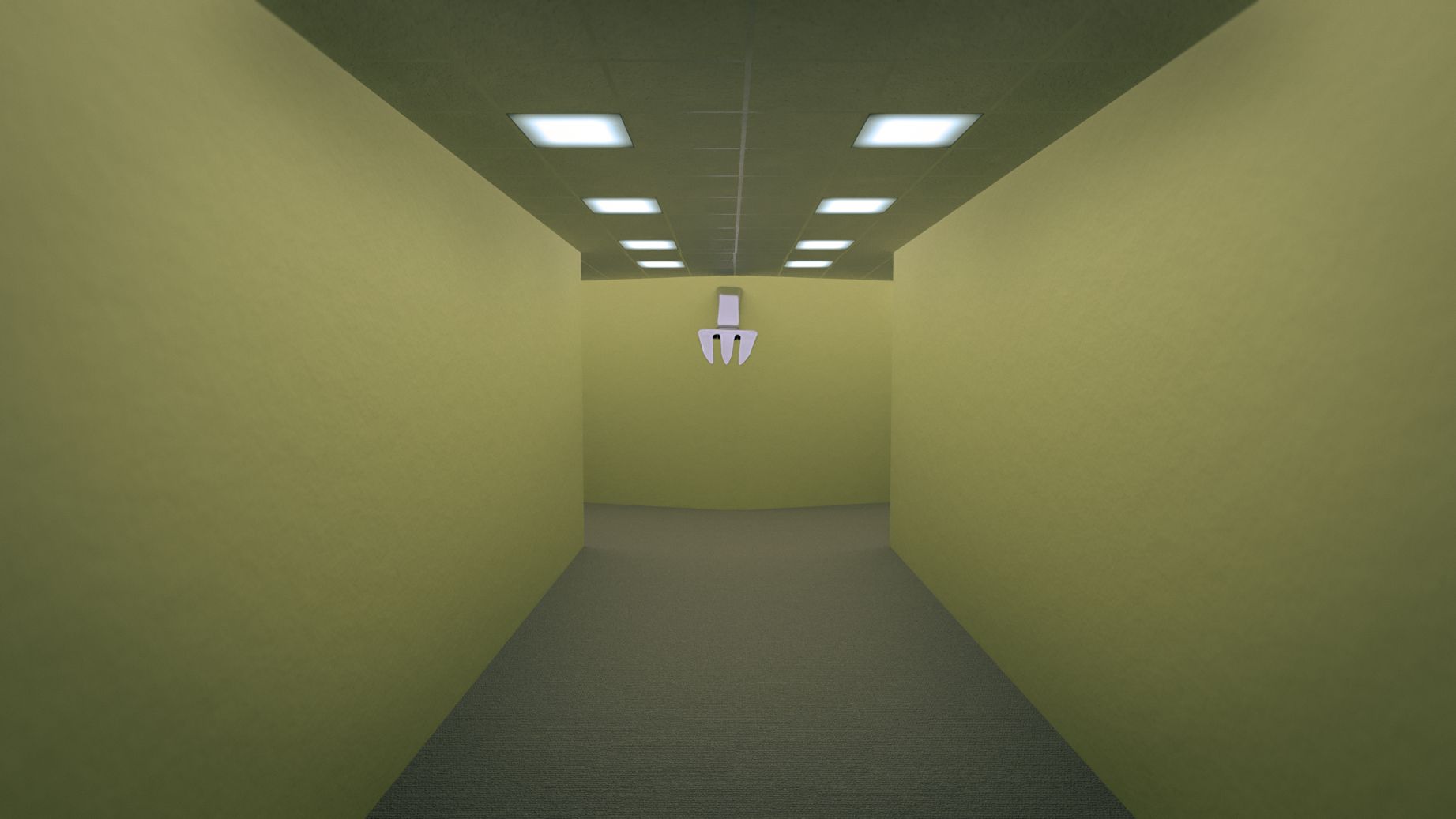
Up ahead, the corridor split. Between the two halls, a comically large fork—twelve feet of stainless steel —protruded from a wall, tines sticking out, the handle half-buried.
Sal couldn’t help himself.
“When you come to a fork in the road... take it!”
He grabbed the tines. His gloves slipped on the steel.
The fork jerked loose from his grip and struck the wall with a deep, metallic gong; the sound began to reverberate, but as it hit the walls... it stopped. Just cut off.
Sal blinked. “Okay... what the hell was that?”
“C’mon, doesn’t matter. Pick a route.”
“Left.” Sal said after a moment.
“Mmmm...” said 1080 while thinking. He shook his head. “Nah. Right.”
“Right it is.” Sal muttered.
They passed a wall of lockers with dented metal. One of them hung open.
1080 stopped.
“Here,” he said, breath fogging the visor.
Inside sat a flashlight. Dimitri’s name was scratched into the handle, half-covered by faded soccer ball stickers.
Sal picked it up.
“Kid had style.” He clicked it on.
The beam cut through the dim corridor. Dust motes drifted slowly in the light.
Something shifted in the wallpaper ahead.
A ripple.
Like a hand pushing from the other side.
Both of them leaned closer.
The wall swelled outward briefly— something like a forearm pressing through thin skin —then slid back into place.
1080 frowned.
The floor dipped slightly under his boot, soft as meat.
Something else moved.
1080 quickly turned his head. Just for a second.
“Sal...?”
No answer.
“SAL?!”
“Can you please stop yelling me?” the Sal-like voice misspoke. “You’re starting to stress me out.”
1080 froze. Then he unshouldered his rifle.
Don’t, said the room.
Or maybe Do.
He fired.
The recoil punched his shoulder.
The bullet struck the wall, the chevron arrows accepted it like a frisbee. Absorbing it. A second later, the wall exhaled and spat the smoking bullet onto the carpet.
The wallpaper blistered. The soccer ball near the corner rotated. A knuckle bulged briefly on its surface, from within, then smoothed.
“Dimitri?” 1080 asked, staring at the ball.
The voice came from everywhere at first, through metal and static: “Here. But not where you’re looking.”
“Are you okay?”
“Okay’s for one thing,” the voice said, as if sliding down one of the pipes on the wall. “I’m in the fix now. We’re part of the fix. Don’t worry.”
“Fix... what?”
“The forgetting.” said the vent. “It’s quieter if we help.”
The hum deepened. He switched off the flashlight. The darkness had texture, thick as velvet. When the lights blinked back on, the room had changed: drawers now where dominoes had been, the fork deeper in the wall, the “Non-Euclidean Instability Hazard” sign now stood here.
“Huh, so maybe they’re not dead,” he whispered, realization burning through him. “Just... sealed away.”
“When you join the fix,” said the vent, “it’s loud. Later it gets quieter. Later still, quiet is the shape of you.”
“SAL!” 1080 yelled at the wall. “I know you’re in there! Say anything, please!”
“Stop—” another voice began, and he knew the timbre even through static. “—yelling me.” it continued, misspoken. “You’re st-st-star star-t-ing to stress me out. We’re— huff —good. It’s okay. There’s... work.”
“Work?”
“Keeping”, the wall said. “Holding. Remembering.”
The complex always chose the path of least resistance. The pattern clicked into sense. alarm → stairwell → drip → hum → voice. Noise had been the start. It paid in repetition. A body made of rooms; or perhaps, a room made of bodies.
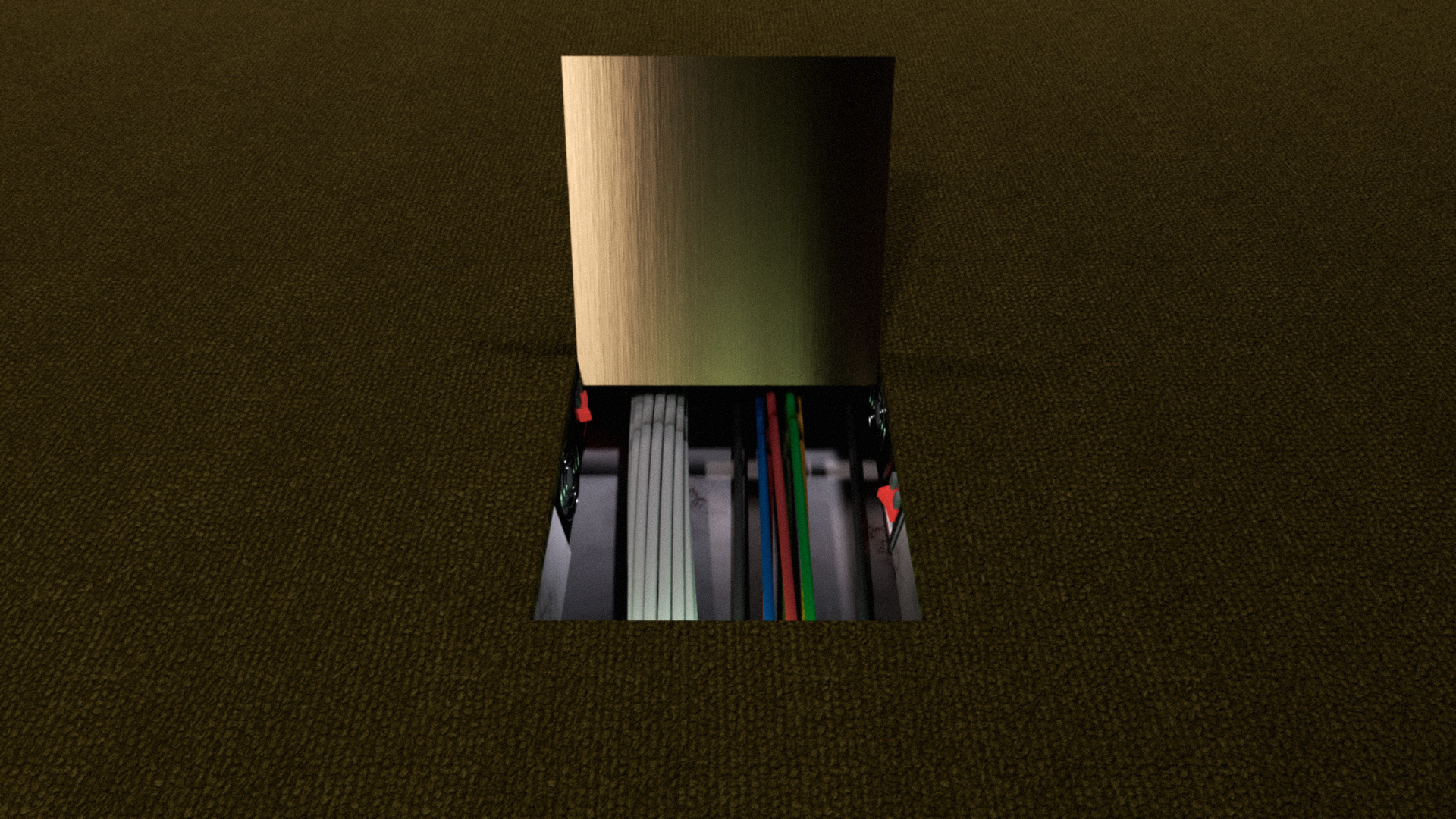
A panel unlatched in the floor beside him. Inside, a maintenance nook full of fiber lines and small fans exhaling warm, bread-scented air. The nook’s rhythm matched his heart until his heart matched its. He let the rifle strap fall. The bullet on the floor steamed quietly, content to be irrelevant.
He placed his gloved hands on the panel’s edge. It accepted his weight like a friend leaning in. ‘Silence isn’t absence’, he thought. ‘It’s just another form of participation. If they’re all together... maybe I don’t want to be alone.’ He then murmured, “The Complex remembers better than people do.” And the walls agreed.
The woods held its breath.
Evening leaned over the ridge, and the birches made a thin-bones lace against a bruised sky. Leaves skittered across the path in small, nervous herds. The air carried a sweet, metallic thread, like pine sap and rust braided together, tasting like burnt sugar and static. Cicadas wound down. Somewhere below, a generator coughed to life, exhaling warmth into the cooling forest.
The valley looked fossilized. Sap smell hung low, syrup and ozone. A heron dragged its shadow across the surface of a drainage pond, its wings brushing fog.
The pond rippled once, then went still again. From beneath, a dull mechanical wheeze, some buried vent, sent up a pulse of warm air, bending the cattails. The forest shifted, uneasy, as if the earth below it had started to breathe through machinery.
Further on, a pair of floodlights blinked on behind a chain-link fence, turning the mist to silver. Moths jittered through the beams, but their wings didn’t cast shadows; light swallowed them whole. For a long moment, the hillside looked like a still life painting that had forgotten to stay still. The breath of the woods slid down into the valley, where a low hum answered like a throat clearing.
The night balanced on its own hum. Then, with a single ‘click’, it fractured. A light tore open the valley, and the stillness that had been painting itself across the trees cracked like varnish.