Short Fiction
Just This Once
Behind the school’s library, a narrow path runs between a row of black birch trees, their brown-and-white-dotted bark peeling in curls, as if they’re shedding old versions of themselves. The path dead-ends at a blank stone wall. Or it’s supposed to, anyway. A week ago, I tripped on broken concrete, slammed shoulder-first into that wall, and it gave way like wet cardboard.
On the other side was a narrow room, lit from nowhere; dust, cold air, and two plinths in the center. On each one: a fist-sized stone, dark and smooth like polished granite.
There were words carved into them, shallow and old:
“Let desire be the hand that shapes the self.”
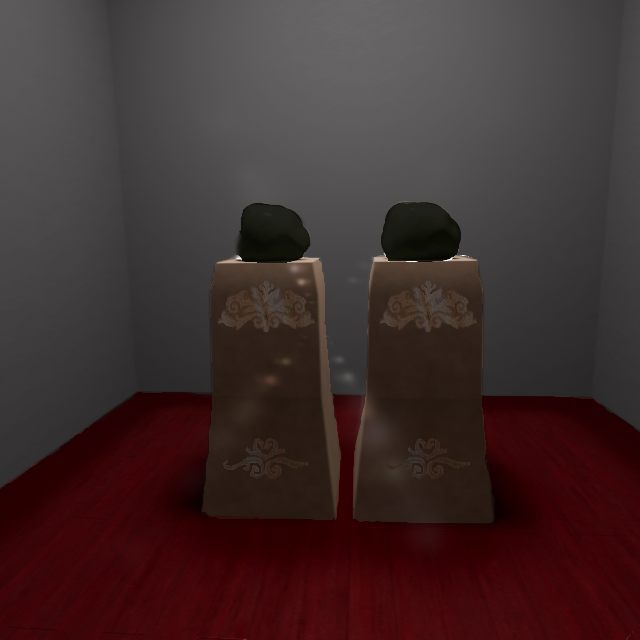
I wondered if I’d concussed myself. I touched one of the stones, my finger gliding over its shallow grooves. For a second, the letters felt warm. Then the wall was solid again, and I was outside alone.
I thought the wall swallowing me was the strangest part. I was wrong about that.
Two hours later, I walked into the lower level of the school’s Innovation Center. The tech room in the building’s basement hummed with various machines. The lights are bright, reflecting off the white walls, the air smelling faintly of melted plastic and coffee. Monitors line the walls, each one a little world in progress: code windows, CAD schematics, swirling particle simulations.
I stand in the doorway with my Wells High School campus ID card twisting between my fingers, pretending I belong here.
At the back, someone’s 3D modeling in Blender. Even from here, I can tell they’re good. His screen shows a meticulously modeled old house: a vintage kitchen, a living room, textures so convincing they could be memories. His stylus moves with practiced confidence, orbiting the scene like he’s conducting it.
I drift closer, pulled by the movement on the screen. The modeler is a guy with messy hair and noise-cancelling headphones, hunched in that way people get when they’ve forgotten their body exists. He radiates pure competence.
I want it.
Not in a vague, “wouldn’t-that-be-nice” way. Something sharper, clean and bright. I want his ease, his shortcuts, the way his fingers dance instead of stumble. I want to sit down and make a world that obeys me, vertex by vertex.
The stone in my pocket—the one I shouldn’t have, but apparently must have made its way into my possession after my initial encounter with it—goes warm. Then hot.
I flinch.
On the screen, the texture he’s UV mapping flickers, geometry stuttering. His stylus freezes. His hand trembles.
“Hey, are you okay?” I manage to get out, my voice coming out thin, like it has to push through water to get out.
He doesn’t hear me. He’s yanked his headphones off, eyes unfocused. Color fades from his face as if someone’s sliding a saturation switch down. His freckles blanch. The house on the screen collapses into a mess of angles.
“I—” he says, and swallows. His throat sounds like it’s forgotten how to work. “Weird. I feel... weird.”
The stone in my pocket is burning now, but there’s no pain, just pressure, like someone has a fist around my solar plexus and is squeezing. It’s like something is being pulled out of him and pushed into me—not blood or breath, but ability, knowledge, some essential thread.
“I’ll get someone,” I say. “You should sit down.”
He tries. His legs don’t respond right. He folds instead, slowly, like a puppet whose strings are being loosened one at a time. A girl at the 3D printer gasps. A chair scrapes. Someone shouts for an adult. Someone screams for help. Voices stack.
I stagger back from him like distance will help him. It doesn’t. The pressure continues, low and tidal. In front of us, his graying face frozen mid-expression. The overhead hanging lights continue to buzz, like insects.
A minute ago, I could barely tell a face loop from a crash log. Now, the mess of vertices on the screen... makes sense.
My gaze snaps to a band of edges along the antique table. They’re too tight; the topology will pinch in animation. The thought isn’t mine. Or, it is, now? My fingers itch, knowing exactly which hotkeys would fix it.
“Can you call 9-1-1?!” someone asks me. Another person kneels by the guy, checking his pulse.
I nod, but my hand doesn’t go to my pocket. It goes to the mouse.
Just to slide it out of the way, I tell myself. Just so no one knocks it over.
The moment I touch the mouse, the rest of the noise drops out. My index finger rests on the left mouse button like it’s done this a thousand times.
I tap. Drag. Use a shortcut I’ve never learned. The mesh obeys. The rush feels wrong; wrong and perfect, like slipping into someone else’s skin and finding it fits better than your own.
“What are you doing?” the girl with the 3D printer says. Her voice comes from far away. “Shouldn’t you—”
“I’m—” I start, and realize I don’t have an answer that makes sense.
People around us cluster. Someone props the guy’s head up with their hoodie. Someone else fans his face with a notebook. His skin is the color of paper ashes now. Even his hair looks dull, like the shine’s been scrubbed out. There’s a fine gray dust on his fingers that wasn’t there before.
The stone in my pocket cools down to a steady warmth.
I let go of the mouse. The spell, or whatever this is, breaks just enough for my heart to slam me back into awareness.
“I’ll... I’ll go get a school security guard.” I choke out.
I back away so fast I nearly trip over a rolling stool. No one stops me; they’re all focused on the limp figure on the floor.
The quiet of the hallway is worse. My footsteps echo too loudly. The glass wall shows the tech room from the outside: a little aquarium full of panicked fish and the gray, crumpled body at the bottom.
I press my fist into my pocket, knuckles scraping against stone. The inscription flashes in my mind. “Let desire be the hand that shapes the self”.
Through the opposite windows, the campus green stretches out in the afternoon light. A group plays Ultimate Frisbee, bright disks arcing between them. One player cuts across the grass, fast and effortless, legs eating distance. He looks like the kind of person who could run for miles without noticing.
I think (without meaning to): I wish I could do that.
The air tightens, just slightly. The runner stutters mid-stride. His next step lands heavily. His shoulders hunch, hand going to his chest like the wind’s been punched out of him. The frisbee sails past him, un-caught.
I look down at my shoes. They suddenly feel too light, like I could bolt without losing my breath. My lungs feel... new. Deeper.
No.
I turn away from the window. I fix my eyes on the linoleum, on the scuffed arrow decals pointing to EMERGENCY EXIT, like following instructions will save me.
At the far end of the hall, a girl leans against one of the many lockers on the wall, a sketchbook balanced on her knees, charcoal smudging her fingertips. Her drawing is all clean lines and shadows that actually look like shadows. As I pass, my brain starts its old loop: “How does she make it look so easy?” I had to get rid of it.
“Don’t want it. Don’t want it. Don’t—” I quickly chanted in my mind.
The stone warms anyway, a pulse against my thigh.
I push out the side door into fresh air that smells like cut grass and car exhaust. The sky is offensively blue. Students cross the quad in clusters, laughing, arguing, carrying laptops and portfolios. Each one a little constellation of things I don’t have.
Didn’t have.
My hands still hum with stolen knowledge. My stomach twists. It should be just horror and guilt, crawling and cold. Which are there, somewhere underneath.
But braided through them is something else. Bright and awful and clean. It feels good. Too good.
Across the quad, two guys are setting up an amp and a mic, laughing as they untangle cables. One of them tests the mic, singing a line of some song. His voice is clear and easy, no strain.
The wanting rises, automatic now.
I squeeze the stone in my pocket until its carved edges bite my palm and I whisper, to no one, to myself, to whatever’s listening in the dark space behind the library: Just this once. Then I’ll stop.
Before the stone, I did have one gift. I could spot black birch trees. From any distance, any angle. Their brown-with-white-dots bark always stood out to me. My one dumb “party trick”, I guess. I’d peel off the outer layer and chew it; just a thin curl. It tasted like wintergreen gum left too long in your pocket, something between root beer and mint.
There’s one across the street now, just past the curb.
The sight of it steadies me for a second. Makes me feel like the version of myself from before; before the faux room, the plinths, before the stone warmed to life in my palm.
I start toward it.
That’s when I hear footsteps behind me; soft, quick, purposeful. A girl’s voice: “Heyy, sorry, can I ask you something?”
I turn. I don’t think I recognize her from any of my classes. She’s my age, maybe younger, with hair tied back in a messy knot, wearing our high school’s hoodie, backpack half-unzipped. Ordinary. Completely ordinary. But she keeps glancing past me, toward the black birch tree across the street.
“You... know trees, right?” she asks, almost embarrassed. “Are those, uh, birches?”
I follow her gaze. “Black birches, yeah. I can always spot them. The bark pattern just... jumps out at me. It’s stupid, but it’s kind of my thing.”
“Oh,” she murmurs, almost to herself. “God, black birches. I could never pick them out as a kid. My mom used to show me how to take off the bark when she’d spot one; I always wished I had an eye for them like she did.”
There’s something gentle in the way she says it; admiration, maybe. Or longing.
But then I notice it: A rounded bulge in her pocket. Smooth outline.
Fist-sized.
My chest tightens.
“Uh… hey,” I say carefully, “where did you—”
But the question never finishes. The air around us pulls tight. Her eyes flick back to the birch tree, and I feel it; her wanting. Small but focused, pointed like a hand gripping something just beneath my ribs.
My stomach cinches, like someone threaded a wire through me and yanked.
She keeps staring at the black birch like she’s solving a puzzle with her eyes. Her lips part slightly.
The wire tightens.
Something rips through my chest.
Not metaphorically.
Viscerally; a physical tearing.
My knees nearly buckle as a heat flares under my skin, then drains. Like someone yanked a plug out of me and everything inside is rushing toward the floor.
Pain spikes through my ribs, sharp and electric. My fingers go numb at the tips first, then stiff. My breath catches in a shallow, scraping gasp.
The girl blinks, confused, and takes a step back. “Are you okay?”
“No. No. No, no, no, no!!”, is what went through my head.
My vision pulses dark at the edges. Not just dimming, though; desaturating. My vision washes out, and I can feel it leaving me; the part of me that could always find a black birch tree, pulled out like roots.
My pocket throbs with matching warmth. A call-and-response. A predator scenting another predator.
When I came to, everything was gray, except the stone. It pulsed faintly in my pocket, warm against my skin. And God help me, the first thing I felt was the urge to want something back.