Revised and Expanded Essay
The Backrooms and Liminal Spaces: Introduction
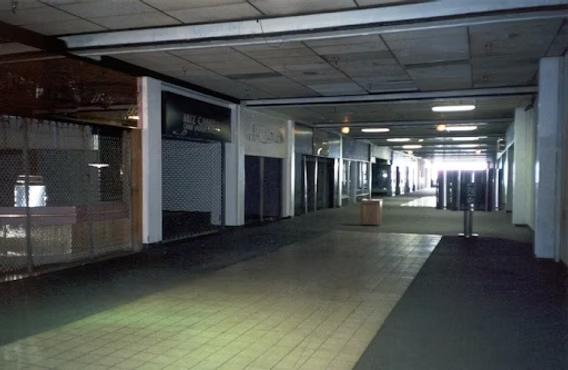
Have you ever walked through a school after hours, an empty hotel corridor, a deserted mall, or a waiting room with nobody waiting? Seen pictures of your childhood house that your family no longer owns?
Nothing may be visibly wrong. Yet the place somehow feels off — familiar, but removed from its usual purpose; nostalgic, but unsettling; ordinary, but almost unreal.
That feeling lies at the heart of both general liminal spaces and the Backrooms.
Welcome to The Backrooms and Liminal Spaces! I first became deeply fascinated by these subjects in 2024[1]. I want to make this Space an inviting place for newcomers, longtime fans, artists, writers, photographers, filmmakers, theorists, and anyone else drawn to strange, empty places and the Backrooms.
What is a Liminal Space?
The word liminal refers to something transitional or “in-between”. It comes from the Latin word limen, meaning “threshold”[2][3]. A literal threshold—such as a doorway—is liminal because it exists between two rooms. But a liminal state can also exist between stages of life, periods of time, identities, or uses.
Online, the phrase liminal space[4] has developed a more specific aesthetic meaning. It commonly describes a place that feels caught between purposes, periods, or realities: familiar enough to recognize, but presented in a context that makes it feel strange.
Common examples include:
- A school hallway late at night
- An empty airport terminal
- A hotel corridor with no visible end
- A deserted shopping mall
- A vacant office
- A finished basement with no furniture
- A playground or indoor funhouse after closing
- An empty tiled pool room
- An empty parking lot illuminated at night
- A building that is being constructed, renovated, or abandoned
Not every liminal space must be frightening, abandoned, or literally transitional. The term is used broadly online, and people disagree about its exact boundaries. Still, most liminal space images share some combination of emptiness, familiarity, displacement, forlornness, ambiguity, stillness, repetition, and nostalgia .
Why do Liminal Spaces Feel so Strange?
Liminal spaces often show us ordinary environments under extraordinary circumstances.
A hallway is not inherently frightening — but a hallway designed for hundreds of students may feel strange when empty. A waiting room feels incomplete when nobody is waiting. A playground at night retains the shape of childhood fun, but loses the activity that normally gives it meaning.
Something appears to be missing.
Several features can contribute to this effect:
- Familiarity without context: We recognize the type of place, but we may not know where it is, why it is empty, or what has happened there.
- Absence of people: A location built for human activity may feel abandoned or artificial when no people are present.
- Repetition and disorientation: Identical doors, pillars, lights, or corridors can make a space appear much larger—or less logically organized—than it really is.
- Temporal displacement: The décor, image quality, or architecture may seem to belong to another decade, making the place feel detached from the present.
- Ambiguity: The image gives us too little information to determine whether the space is harmless, abandoned, dangerous, or artificial.
- Nostalgia: Schools, malls, play areas, basements, and hotels may resemble places from childhood, even when we have never visited the specific location pictured.
Research into uncanny[5] architecture has found that deviations from the patterns we expect in familiar environments can make physical places feel eerier. The absence or unexpected presence of people can also affect how unsettling a space appears[6].
This does not mean every person experiences a liminal image in the same way. Some people find these spaces frightening. Others find them peaceful, beautiful, melancholic, or even comforting. Many experience several of those reactions simultaneously.
Two poetic words that help describe these reactions are kenopsia and anemoia:
- Kenopsia is “the eerie, forlorn atmosphere of a place that is usually bustling with people but is now abandoned and quiet”[7]. A vacant school hallway, deserted amusement park, or empty shopping mall can evoke kenopsia because the place retains evidence of the people and activity that are no longer there.
- Anemoia describes nostalgia for a time or place one has never personally known[8]. A faded photograph of a 1980s mall, a 1990s play center, the “roarin’ ‘20s” aesthetics, Gilded Age mansions, a foreign country’s buildings, or an unfamiliar childhood home may feel strangely remembered... even to someone who never experienced that particular place or period.
John Koenig coined both words for The Dictionary of Obscure Sorrows[9]. They are evocative neologisms rather than formal psychological diagnoses. Still, they capture two feelings that frequently overlap in liminal space imagery: the absence of what was once present, and the memory of something we never actually experienced.
So, What is “The Backrooms”?
The Backrooms is a fictional realm inspired by the unsettling possibilities of liminal space.
At its simplest, the Backrooms[10] is an apparently endless (or rather, unfathomably large) maze of vacant rooms, corridors, and other human-made environments. The architecture is recognizable, yet… irrational. Rooms repeat, passages are so roundabout and asinine, and the scale of the place seems impossible.
The most original and most famous version (see Figure 02 below) consists of yellowed wallpaper, damp-looking carpet, fluorescent ceiling lights, and monotonous rooms stretching far beyond sight.
The Backrooms turns a temporary liminal experience into a permanent one. You are no longer passing through the empty hallway on your way somewhere else. There may be no destination, recognizable exit, or world waiting on the other side.
You are simply there.
How the Backrooms Began
The Backrooms began with a photograph.
On May 12th, 2019, an anonymous user on 4chan’s paranormal board, /x/, created a thread asking people to share “disquieting images that just feel ‘off’”[11]. One of the images showed a strangely configured, yellow-tinted commercial interior with fluorescent lights, patterned wallpaper, and no people.
Two days later, another anonymous user responded with a short piece of horror writing that began with:
“If you’re not careful and you noclip out of reality in the wrong areas, you’ll end up in the Backrooms…”
The rest of the post described millions of square miles of “mono-yellow” randomly segmented rooms, old carpet, buzzing fluorescent lights, and the possibility that something might be wandering nearby[12].
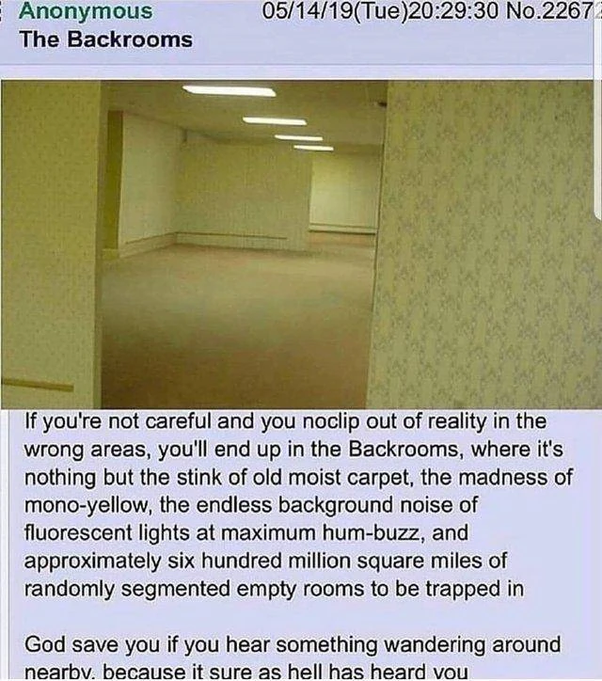
That short “creepypasta[13]” transformed an unexplained photograph into an entire fictional premise.
The term noclip[14] comes from video games. Normally, collision boundaries prevent a player from passing through walls, floors, and other solid objects. When a glitch allows the player to cross them, the player can move outside the intended environment.
The original post imagined that reality might work the same way: step into the wrong place under the wrong conditions, and you could fall outside the boundaries of the ordinary world.
In Backrooms terminology, normal reality is sometimes called “the Frontrooms”[15] (or, per Kane Parsons’ Backrooms lore, “Standard”[16]). These names, like much of the later terminology, were developed by fans rather than appearing in the original post.
From One Post, to a Collaborative Mythology
The original Backrooms concept was minimal: one image, one paragraph, an impossible expanse, and the suggestion that you might not be alone.
Online communities soon expanded it. There’s the Fandom wiki[17], the Wikidot[18], and eventually Kane Parsons’ video series[19], as well as The Backrooms Online[20]. And there’s r/backrooms (the Backrooms subreddit)[21], along with its connected Discord server, r/Backrooms[22].
Writers and artists devised numbered “levels”, unusual objects, survival rules, organizations, entrances, exits, and creatures commonly referred to under the umbrella term of “entities”[23]. Wikis gathered thousands of interconnected pages. Games allowed players to explore procedurally generated corridors. Videos, artwork, stories, and role-playing communities offered their own interpretations. It is important, however, to understand that there is no single version of all Backrooms lore[24].
The original post is the shared foundation, but the major wikis, individual creators, video games, and film projects frequently use different sets of “lore”. A level or entity that exists in one interpretation may not exist in another. Even the idea that the Backrooms contains numerous numbered levels and monsters is a later development, not a requirement of the original premise.
That creative openness is one reason the Backrooms became so widespread. The concept is less like a conventional franchise with one authoritative storyline, and more like a modern form of folklore: people encounter a simple idea, reinterpret it, and contribute new stories of their own.
Some fans prefer elaborate lore filled with levels, entities, and organizations. Others prefer the pure ambiguity and isolation of the original post. Both approaches—and the many possibilities between them—can produce compelling work.
Kane Pixels and the Rise of Backrooms Video
The Backrooms reached another enormous audience through filmmaker Kane Parsons, also known online as “Kane Pixels”[25].
On January 7, 2022, Parsons released “The Backrooms (Found Footage)” on YouTube. The short film follows a cameraman who falls into an impossible environment of vacant yellow rooms and records his attempt to escape[26].
Created primarily with Blender and designed to resemble recovered VHS tape footage, the video transformed the familiar still image into a place audiences could seemingly enter and explore. Its subdued lighting, camera movement, architectural scale, and limited explanations preserved much of the original concept’s ambiguity.
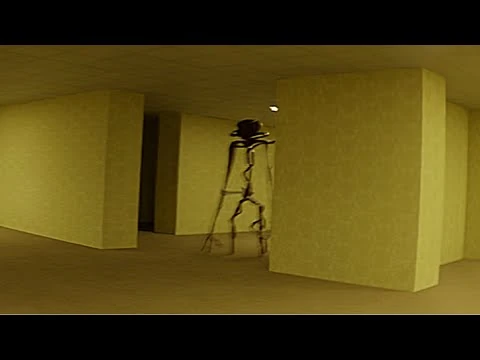
Parsons continued the project through a series involving the fictional Async Research Institute[27], which discovers and investigates the spatial anomaly. His continuity is highly influential, but it remains his interpretation of the Backrooms, rather than a universal canon governing every other version.
The series’s success ultimately led to the 2026 A24 feature film Backrooms, directed by Parsons and written by Will Soodik[28]. The journey from an anonymous image-board post to community fiction, viral filmmaking, games, art, and a major motion picture is an extraordinary example of how internet folklore can evolve.
Backrooms Creators, Analysts, and Theorists
Kane’s success also helped inspire a much larger ecosystem of filmmakers, animators, analysts, and theorists.
One notable example is Complex Research[29] (formerly known as Async Research). The channel creates original Backrooms films using 3D-rendered environments, found-footage presentation, and visual techniques influenced by the cinematic language that Kane Pixels helped popularize. Although the videos may feel stylistically related to Kane’s work, Complex Research develops a separate interpretation and continuity of its own. Other noteworthy Backrooms YouTube creators include (but are certainly not limited to) Alfarex, RegularlyBlue, Gorilla CGI, and The L Factory.
Other creators approach the Backrooms by examining and interpreting its mysteries. YouTubers such as Wendigoon, Red, and greg_nog have helped viewers explore timelines, environmental clues, scientific ideas, symbolism, unanswered questions, and possible explanations within Kane Parsons’s version of the Backrooms.
Theory videos are not necessarily statements of confirmed canon. Their value comes from assembling evidence, proposing connections, and encouraging audiences to look more closely at stories that are deliberately incomplete. This analytical community has become another important part of the Backrooms phenomenon: creators construct the mystery, and viewers participate by trying to understand it.
The Real Location Behind the Original Image
For years, the origin of the famous photograph remained unknown.
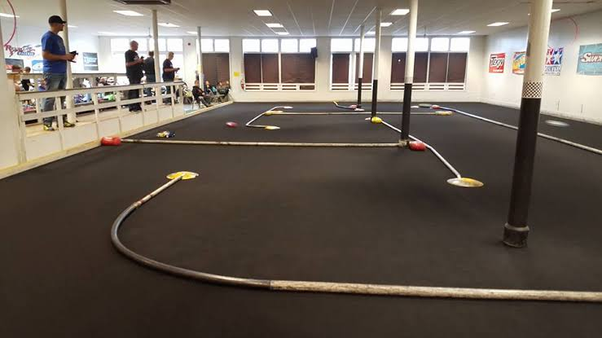
In 2024, internet researchers traced it to an archived webpage for a HobbyTown location in Oshkosh, Wisconsin. The image had been taken during renovations to the second floor of a former furniture store and appeared on the business’s website in 2003[30].
The strange yellow interior was therefore not computer-generated, paranormal, or designed as a horror set. It was a camera-tinted ordinary real-world space photographed during a temporary stage in its renovation.
The building has since changed considerably. The area where the photograph was taken is now used as a carpeted track for radio-controlled cars, and little remains of the room’s original appearance[31]:
Does learning that the room was real ruin the Backrooms?
For some people, it might change the mystery. For me, however, the discovery makes the story even more interesting.
The supernatural lore is fictional, but the place that inspired it existed. It was a genuinely transitional environment: a commercial interior between its former identity and its future use. In that sense, the original Backrooms photograph was not merely made to look liminal. It captured a building at an actual threshold in its history.
Are Liminal Spaces Real?
The Backrooms is fictional. Liminal spaces are not.
A deserted hallway, empty mall, unfinished room, closed amusement center, or silent office can genuinely produce the complicated mixture of recognition, nostalgia, curiosity, comfort, and unease that defines the aesthetic. No monsters or supernatural explanations are required. Often, the most powerful feature is precisely that nothing visible is happening.
The imagined horror of the Backrooms begins with a real experience: entering a familiar kind of place at an unfamiliar time and suddenly becoming aware of its emptiness. The fiction asks what would happen if that moment never ended; if the transitional place ceased to be a passage and became the entire world.
That is why the Backrooms and liminal spaces belong together, while remaining distinct:
- Liminal spaces are real places, images, and experiences associated with transition, displacement, emptiness, familiarity, or uncanniness.
- The Backrooms is a fictional world that turns those qualities into a potentially endless setting for horror, mystery, exploration, and storytelling.
Why These Concepts Resonate
The Backrooms does not need ghosts, graveyards, or obvious monsters to create fear. They transform some of the most ordinary features of modern life—carpet, office lighting, drop ceilings, corridors, and commercial interiors—into something vast and unknowable.
They blur several boundaries:
- Familiar and alien
- Safe and threatening
- Real and artificial
- Remembered and imagined
- Temporary and endless
- Empty and possibly occupied
A liminal image rarely gives us a complete story. Instead, it creates a gap, and our minds begin trying to fill it. “Where is this place?” “Why is nobody here?” “Have I seen it before?” “What is around that corner?”
That uncertainty is where much of the fascination lives.
About the Curator
I’m Aaron L. Schlossberg, a web developer, entrepreneur, writer[32], and active participant in the broader Backrooms community. I currently own the r/Backrooms Discord server[33], where I help manage the community and organize discussions, activities, and creative initiatives. I also help moderate the community surrounding Complex Research[34] and have been involved in Backrooms-related community coordination, creator collaboration, and event coverage.
I am also the founder of Fiction2Reality[35], a long-term creative venture exploring how fictional spaces— including the Backrooms —can be developed through storytelling, digital art, 3D environments, and film, with the eventual ambition of transforming fictional settings into physical places people can explore.
Through this Space, I aim to spotlight the concept of liminal spaces, preserve the history of the Backrooms, spotlight the people creating and analyzing it, encourage original work, and make the subject accessible to newcomers without flattening its many different interpretations into any single “correct” canon.
What You can Expect from this Space
The Backrooms and Liminal Spaces will explore both the fictional Backrooms and the broader real-world aesthetic of liminality.
Posts may include:
- Liminal space photography and artwork
- Backrooms history and internet folklore
- Explanations of different levels, entities, and lore
- Discussions of what makes particular spaces feel uncanny
- Backrooms videos, games, stories, and creative projects
- Creator spotlights, theory breakdowns, and behind-the-scenes material
- Questions, theories, interpretations, and debates
- Original fiction, artwork, renders, photography, and filmmaking
- Real-world locations connected to famous liminal images
No previous knowledge is required. You do not need to memorize a wiki, accept one particular canon, or even enjoy [psychological] horror. Curiosity is enough.
Contributors and visitors are welcome to share their work and perspectives. When posting, please credit original creators whenever possible and make it clear whether something is documented history, personal interpretation, or fictional lore.
If empty corridors, forgotten rooms, impossible architecture, internet folklore, strange nostalgia, or the quiet fear of the unknown interest you, please follow the Space, turn on notifications, and join the conversation!
Footnotes
- How I discovered the Backrooms: TikTok video ↩
- Merriam-Webster, “Liminal”: definition ↩
- Merriam-Webster, “threshold”: definition ↩
- “Liminal space” definition: Wikipedia ↩
- “Uncanny valley”: Wikipedia ↩
- Alexander Diel and Michael Lewis, “Structural Deviations Drive an Uncanny Valley of Physical Places,” Journal of Environmental Psychology: DOI ↩
- John Koenig, “Kenopsia,” The Dictionary of Obscure Sorrows: source ↩
- “Anemoia” definition: Wiktionary ↩
- The Dictionary of Obscure Sorrows: website ↩
- Definition of the Backrooms: Wikipedia ↩
- Archived 4chan thread ↩
- Internet Archive, “The Backrooms of the Internet Archive”: article ↩
- “Creepypasta” definition: Wikipedia ↩
- “noclip” definition: Wiktionary ↩
- The Frontrooms ↩
- Kane Pixels Backrooms discussion ↩
- Backrooms Fandom Wiki ↩
- Backrooms Wikidot ↩
- Kane Parsons’s Backrooms playlist ↩
- The Backrooms Online ↩
- r/backrooms ↩
- r/Backrooms Discord server ↩
- Backrooms Wikidot entities ↩
- Discussion concerning Backrooms canon ↩
- Kane Pixels’s YouTube channel ↩
- Kane Pixels, The Backrooms (Found Footage): YouTube ↩
- The Async Research Institute: Kane Pixels Backrooms Wiki ↩
- A24, Backrooms (2026): film page ↩
- Complex Research’s YouTube channel: YouTube ↩
- Wikimedia Commons, “HobbyTown USA Oshkosh Interior Under Construction”: image history ↩
- Wisconsin Public Radio, “Horror Film ‘Backrooms’ Inspired by a Meme Born in Oshkosh”: article ↩
- Aaron L. Schlossberg as a writer: Writings ↩
- r/Backrooms Discord server invite: Discord ↩
- Complex Research Discord server: Discord ↩
- Fiction2Reality Frequently Asked Questions: FAQ ↩